

WHAT ARE BAREFOOT SHOES?
Barefoot shoes, or also called minimal shoes, are shoes that restrict the natural movement as little as possible while allowing the feeling of walking barefoot as much as possible.
Walking barefoot is healthy for the body, muscles, and sensorimotor functions and is recommended by many experts.
Trending for several years and supported by scientific studies, barefoot shoes differ from traditional shoes in many ways. The main features are:
Flexible sole, toe freedom, zero heel and real lightweights.
Our barefoot shoes also meet these criteria.
Flexible sole
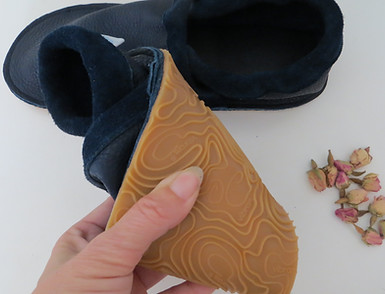
Flexible sole: Unlike conventional shoes, the soles are very flexible, allowing them to be twisted and bent in any direction. This barely affects the foot's natural rolling motion.
Toe freedom

Barefoot shoes have a wider forefoot than traditional shoes. This allows plenty of room for the toes. Each individual toe can respond to signals from ground contact, for example, with grasping movements. This constantly engages the foot and leg muscles, strengthening them and stabilizing the overall running movement.
Zero sales

Unlike traditional shoes, barefoot shoes don't have a raised heel or cushioning. There's no difference in height between the heel and forefoot (the so-called drop). This allows the wearer to place their midfoot or forefoot on the ground. This, in turn, is much more in line with a natural running technique.
Lightweights

Barefoot shoes are very lightweight. The advantage of lightweight shoes is that they don't influence leg movements like additional weights. The heavier the shoes, the more the leverage changes when running. With heavy shoes, the legs swing much further forward than is the case with a natural running style.
Barefoot shoes and health

Walking and running in barefoot shoes has many health benefits over traditional shoes. Some of the advantages include:
Supports natural running motion: Barefoot shoes promote natural running motion. The foot strikes less on the heel and more on the midfoot and forefoot, as occurs with natural walking. This protects joints and bones and has a positive effect on posture.
Strengthening of the foot and leg muscles: Muscles and ligaments in the foot and lower leg area are challenged more, thus becoming stronger. The body's natural ability to cushion the running motion improves.
Improved blood circulation: Blood circulation in the feet and legs is stimulated.
Promotes sensorimotor skills: Improved ground contact promotes sensorimotor skills, the interaction between muscles and the nervous system. The sense of balance is also addressed and trained.
Running has to be learned

Wearing barefoot shoes requires a certain amount of adjustment. The body needs time to adjust to the new freedom for the feet. The adjustment period varies from person to person. Keep in mind that most people are no longer used to running barefoot. Over the course of a lifetime, muscles, joints, ligaments, and tendons have adapted to running, jogging, or hiking in traditional shoes that supposedly relieve pressure on the feet and legs.

Our barefoot shoes
REAL FAVORITE SHOES
THE INTERACTION OF THE SOFT LEATHER WITH THE FLEXIBLE VIBRAM SOLE DOES NOT CONTRACT THE TOES, THEY ADAPTE AS YOU WEAR THEM.
THE SHOES ARE SEWN IN A WAY THAT THE RUBBER PREVENTS THE FOOT FROM SLIPPING FORWARD.
Our new shoe models are sewn with the seam facing inward. On our website, you'll find many more models with the seam facing outward. The overall feel remains largely the same. Visually, there's a small but subtle difference.
Gluing the Vibram sole to the suede side, rather than the smooth leather side, has the advantage that the sole stays in place even when the shoes get wet.
